
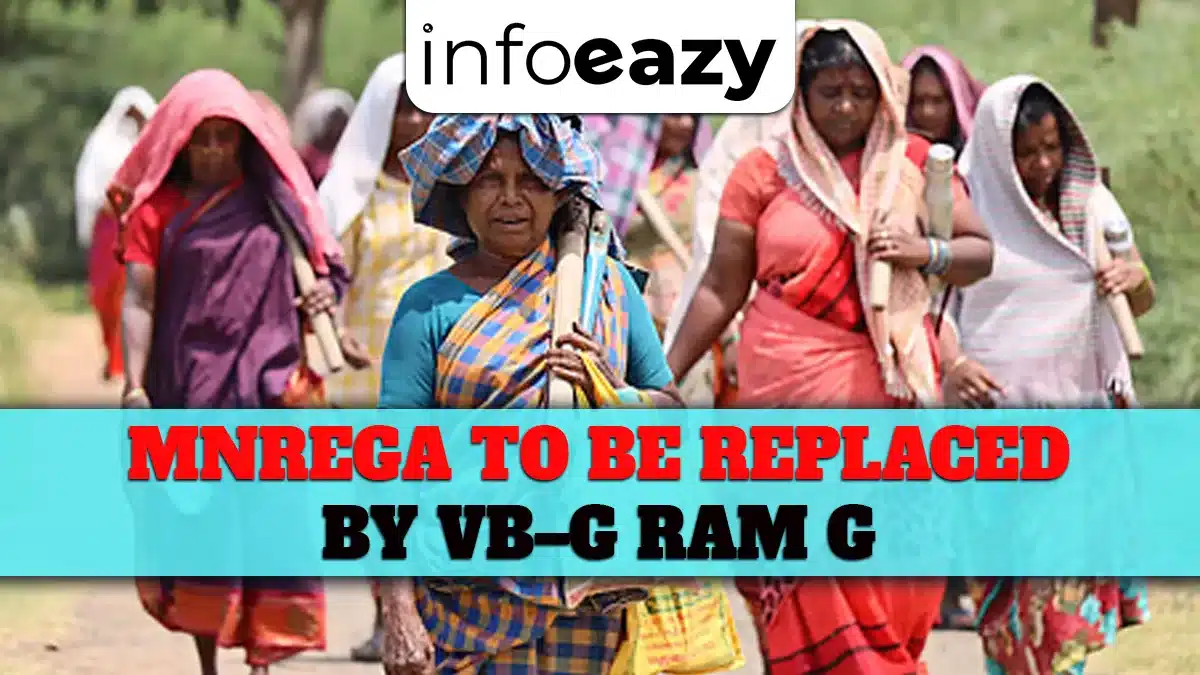
The proposal to replace Mahatma Gandhi National Rural Employment Guarantee Act, 2005 (MNREGA) with the VB-G Ram G Scheme (2025) has triggered wide discussion among policymakers, and economists.
This article explains what VB-G Ram G Scheme is, why MNREGA is being reconsidered, key changes, benefits, challenges, and the way forward in a clear, SEO-friendly, and exam-oriented manner.
What is MNREGA?
MGNREGA was launched in 2005, a landmark social security law that guarantees 100 days of wage employment in a financial year to every rural household whose adult members volunteer for unskilled manual work. It is a demand-driven scheme and plays a crucial role in poverty reduction, rural livelihood security, and asset creation.
According to the Ministry of Rural Development (2023), MNREGA provided over 2.5 cbillion person-days of employment in rural India, reaching more than 50 million households.
Also Read: Pradhan Mantri Jan Dhan Yojana PMJDY
Why is MNREGA Being Replaced?
Despite its importance, MNREGA faces several structural and operational challenges. These issues have prompted the government to consider a reformed alternative like the VB-G Ram G Scheme.
Reasons include:
- Frequent wage payment delays, sometimes extending beyond 30-45 days
- Low asset quality and limited long-term productivity
- Leakages and ghost beneficiaries despite Aadhaar-based systems
- Overdependence on unskilled manual labour with limited skill development
- Rising fiscal burden on the central government
Provisions and Changes under VB-G Ram G Bill 2025
1. Expansion of Guaranteed Employment Days
- VB-G Ram G guarantees 125 days of wage employment per rural household per financial year.
- MGNREGA legally allowed 100 days, with exceptions up to 150 days in drought, disaster-affected, or forested areas.
- Under VB-G Ram G, 125 days is a statutory entitlement, not conditional on special circumstances. (Section 3(1), VB-G Ram G Bill)
2. Change in Centre-State Funding Pattern
- VB-G Ram G introduces a cost-sharing model:
- 90:10 (Centre:State) for Northeastern and Himalayan states, plus UTs with legislature.
- 60:40 for other states and UTs with legislature.
- 100% central funding for UTs without legislature. (Section 22(2))
- MGNREGA funded 100% of unskilled wages centrally; states only contributed to unemployment allowance, ¼ material costs, and administrative expenses.
- This reform increases fiscal responsibility for states.
3. Normative Allocation Replaces Labour Budget
- VB-G Ram G introduces state-wise normative allocations set by the central government. (Sections 4(5) & 4(6))
- Expenditure beyond allocation is borne by the state.
- MGNREGA operated on a demand-driven, labour budget system where states submitted annual work plans and funding requests by January 31.
- Shift converts a rights-based, open-ended scheme into a budget-capped, supply-driven programme.
4. Statutory Pause During Peak Agricultural Seasons
- VB-G Ram G mandates no work during notified peak agricultural periods, aggregating 60 days per year. (Sections 6(1) & 6(2))
- Notifications vary by district, block, Gram Panchayat, agro-climatic zone, and local cropping patterns.
- Helps address farm labour shortages but reduces the effective window for guaranteed employment.
5. Viksit Gram Panchayat Plans & National Infrastructure Stack
- All works originate from Viksit Gram Panchayat Plans, consolidated at block, district, and state levels.
- Aggregated into the Viksit Bharat National Rural Infrastructure Stack covering:
- Water security (irrigation and water-related projects)
- Core rural infrastructure
- Livelihood-related infrastructure
- Extreme weather mitigation works
MNREGA vs VB-G Ram G Scheme Difference
| MNREGA vs VB-G Ram G Scheme Difference | ||
| Aspect | MGNREGA | VB-G Ram G Bill |
| Guaranteed Employment | 100 days (exceptions up to 150) | 125 days statutory entitlement |
| Funding Pattern | Centre 100% for unskilled wages | Cost-sharing with states (60:40 or 90:10), UTs 100% central |
| Payment | Often delayed | Timely, weekly wage payments planned |
| Labour Budget | Demand-driven, open-ended | Normative allocation, capped budget |
| Work Window | Year-round | Excludes 60 days peak agricultural season |
| Asset Creation | Variable quality | Focus on water, climate-resilient, and income-generating assets |
| Planning | State/Gram Panchayat plans | Viksit Gram Panchayat Plans + National Infrastructure Stack |
| Monitoring | MIS reporting | Digitized, real-time monitoring, payments, and audits |
| Skill Development | Limited | Integrated skill-based employment and certification |
Impact on Rural Economy
- Timely and regular wages for rural households, reducing financial stress.
- Increased employment opportunities with 125 guaranteed days of work.
- Enhanced rural infrastructure, including water security, roads, markets, and climate-resilient assets.
- Higher agricultural productivity through improved irrigation and farm-related works.
- Reduced distress migration by providing local employment options.
- Improved efficiency and transparency through digitized planning, payments, and monitoring.
- Skill development opportunities, leading to more productive labor and higher incomes.
- Better alignment with national priorities via integration with PM Gati Shakti and infrastructure stacks.
MNREGA to be Replaced by VB-G Ram G FAQs
Q1. Has MGNREGA been scrapped?+
Q2. How many days of work are guaranteed?+
Q3. What are the funding changes?+
Q4. What are the main focus areas of VB-G Ram G projects?+
Q5. Will employment be affected by agriculture seasons?+
Tags: mnrega to be replaced by vb–g ram g