
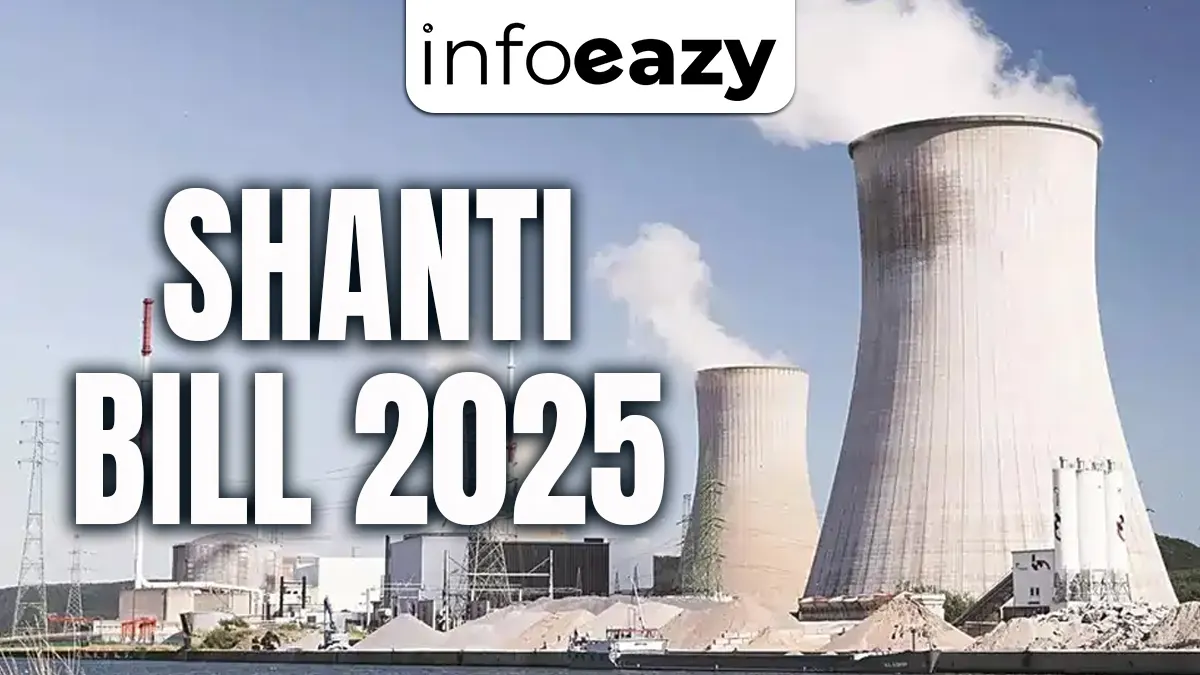
The SHANTI Bill 2025, Sustainable Harnessing and Advancement of Nuclear Energy for Transforming India, is a landmark legislative reform aimed at modernising India’s nuclear energy sector. This bill represents a major shift in the governance, regulation, and development of nuclear power in the country.
By introducing private sector participation, modern liability frameworks, and a unified regulatory structure, the SHANTI Bill seeks to strengthen energy security, encourage investment, and support India’s clean energy goals.
SHANTI Bill 2025
The SHANTI Bill 2025 is a comprehensive law proposed to revamp India’s nuclear energy framework. It aims to replace or amend outdated legislation like the Atomic Energy Act, 1962 and the Civil Liability for Nuclear Damage Act, 2010, creating a modern and simplified legal structure for nuclear energy.
Read Also: MNREGA to be Replaced by VB–G Ram G
Why Was the SHANTI Bill 2025 Needed?
India’s nuclear energy sector was governed by outdated laws that restricted private participation and slowed capacity expansion, limiting its role in meeting rising power demand and clean energy targets.
- Low Nuclear Share: Nuclear power contributes only about 3% of India’s total electricity generation, far below its potential.
- Slow Capacity Growth: Installed nuclear capacity is around 7.5 GW, insufficient for a fast-growing economy.
- High Capital Burden: Nuclear projects require massive upfront investment, which the public sector alone could not sustain.
- Clean Energy Needs: Nuclear energy provides reliable, low-carbon base-load power to complement renewables.
- Climate Goals: Nuclear energy is essential for low-carbon electricity generation, contributing to India’s climate commitments of 100 GW of renewable energy by 2047.
Features of the SHANTI Bill 2025
The SHANTI Bill 2025 introduces transformative changes in India’s nuclear energy landscape. The main features include:
- Private Sector Participation: For the first time, private companies in India can build, operate, and manage nuclear power plants. This step is expected to boost capacity additions and technological innovation.
- Unified Legal Framework: The bill consolidates multiple nuclear laws into a single statute, simplifying licensing, regulatory compliance, and administrative processes.
- Modern Liability Regime
- Caps liability for nuclear incidents at internationally aligned limits.
- Limits operator responsibility to incidents at their installations.
- Exempts equipment suppliers from certain liabilities, making the sector more attractive for private and foreign investors.
- Strengthened Regulatory Authority: The Atomic Energy Regulatory Board (AERB) is given statutory authority to enforce safety, security, and emergency preparedness standards effectively.
- Foreign Direct Investment (FDI): Up to 49% foreign investment is allowed in selected nuclear projects, facilitating technology transfer and capital inflow.
- Specialized Dispute Resolution: Dedicated bodies like the Atomic Energy Redressal Advisory Council and Nuclear Damage Claims Commission will manage disputes and compensation claims efficiently.
Significance of the SHANTI Bill 2025
- Boosts Energy Security: Enables faster expansion of nuclear power capacity to meet India’s growing electricity demand.
- Supports Clean Energy Goals: Promotes low-carbon nuclear energy, aiding India’s climate commitments and net-zero targets.
- Encourages Private Investment: Opens the nuclear sector to private players, easing the financial burden on the government.
- Modernizes Legal Framework: Replaces outdated nuclear laws with a simplified and contemporary regulatory system.
- Strengthens Regulation: Grants statutory authority to the nuclear regulator, improving safety and oversight.
- Promotes Technology Adoption: Facilitates use of advanced technologies like Small Modular Reactors (SMRs).
- Drives Economic Growth: Generates employment and stimulates allied industries such as engineering and infrastructure.
Challenges and Criticisms
- Safety Risks: Private participation may compromise strict nuclear safety standards if regulatory oversight is weak.
- Environmental Concerns: Issues related to radioactive waste disposal and long-term ecological impact remain unresolved.
- Liability Caps: Limited liability provisions may reduce compensation and justice for accident-affected communities.
- Regulatory Effectiveness: Success depends on the independence, capacity, and enforcement power of the nuclear regulator.
- Public Opposition: Local resistance due to safety fears and land acquisition issues can delay projects.
- Security Sensitivity: Private and foreign entry raises concerns over the protection of strategic nuclear assets.
- High Project Costs: Nuclear power remains capital-intensive, potentially increasing electricity tariffs.
- Implementation Gaps: Coordination between the government, the regulator, and private players may pose challenges.
Conclusion
The SHANTI Bill 2025 is a milestone in India’s nuclear energy policy. By opening the sector to private investment, modernising regulations, and streamlining liability frameworks, it has the potential to boost energy security, support climate goals, and attract economic growth. Its success will depend on effective implementation, strong regulatory oversight, and active public engagement.
SHANTI Bill 2025 FAQs
Q1. What is the SHANTI Bill 2025?+
Q2. Why was the SHANTI Bill introduced?+
Q3. What does SHANTI stand for?+
Q4. How does the bill change nuclear energy governance?+
Q5. Can private companies build nuclear power plants now?+
Tags: shanti bill shanti bill 2025